• 30 N Gould St Ste R Sheridan, WY 82801 United States
  • info@solartro.com
+1 307-429-3502

Solar Site Surveys

Accurate, Reliable Site Surveys That Power Faster Design, Permits & Installations

Every successful solar project starts with one critical element: accurate site data.

At Solartro, our Solar Site Survey services capture every essential detail of your project—so your solar systems are designed correctly the first time, permitted smoothly, and installed without surprises.

Before a single panel is mounted or a permit is submitted, we deliver precise, code-compliant, field-verified data that eliminates guesswork, reduces redesigns, and accelerates approvals.

From residential rooftops to commercial facilities, EV infrastructure, and utility-scale projects, our comprehensive site surveys provide your design and engineering teams with everything they need—from roof measurements and electrical assessments to shading analysis and structural verification.

Accurate data in. Faster installs out.

We don’t just inspect sites —

we prepare projects for success.

What’s Included in a Solartro Solar Site Survey

We don't cut corners. Our site surveys are comprehensive, detailed, and engineered for accuracy—capturing every data point your design and permitting team needs.

Exterior & Property Documentation

  • Street view and address verification photos
  • Setbacks, access paths & obstructions
  • Photos of the building exterior from all angles
  • Property line measurements and setback documentation
  • Driveway, walkway, and access path locations
  • Landscaping and vegetation (trees, bushes near roof)
  • Neighboring structures and potential shading sources
  • Roof Inspection & Measurements:
    • Roof type identification & Roof condition assessment
    • Roof orientation, pitch & usable area
    • Roof dimensions & Obstructions mapping
    • Structural condition & attachment feasibility
  • Attic Access & Interior Conditions:
    • Attic entry photos: Location and size of attic access hatch/door
    • Rafter/truss documentation: Wood framing size (2x6, 2x8, 2x10, engineered trusses), spacing (16" or 24" O.C.)
    • Roof decking inspection: Plywood thickness, OSB condition, skip sheathing (tile roofs), signs of rot or water damage
    • Structural concerns: Sagging, cracked rafters, inadequate bracing, load-bearing issues
    • Electrical routing paths: Existing wiring routes, available conduit pathways to route solar DC/AC wiring
  • Advanced Measurement Technologies:
    • Drone-Based Site Survey (where permitted): High-resolution aerial imagery, 3D roof modeling, LiDAR-accurate measurements (±1/4" precision)
    • Ground-based measurements: Laser distance meters, digital inclinometers, GPS-enabled measurement tools
    • Satellite imagery verification: Google Earth/Nearmap cross-reference for property context

Advanced Shade & Solar Access Analysis

  • Comprehensive Shade Assessment::
    • Solar path analysis: Year-round sun exposure evaluation (winter solstice to summer solstice)
    • Obstruction identification: Trees, chimneys, neighboring buildings, hills, antenna towers
    • Shade impact quantification: Percentage of shading by time of day and season
    • Horizon scan: 360° horizon profile showing all potential shading sources
    • Solar access percentage: Annual solar access rating (typically target >90% for optimal performance)
    • Suneye/Solmetric data: Professional shade tools providing TSR (Total Solar Resource) and TSRF (Total Solar Resource Fraction) values

Electrical & Utility System Assessment

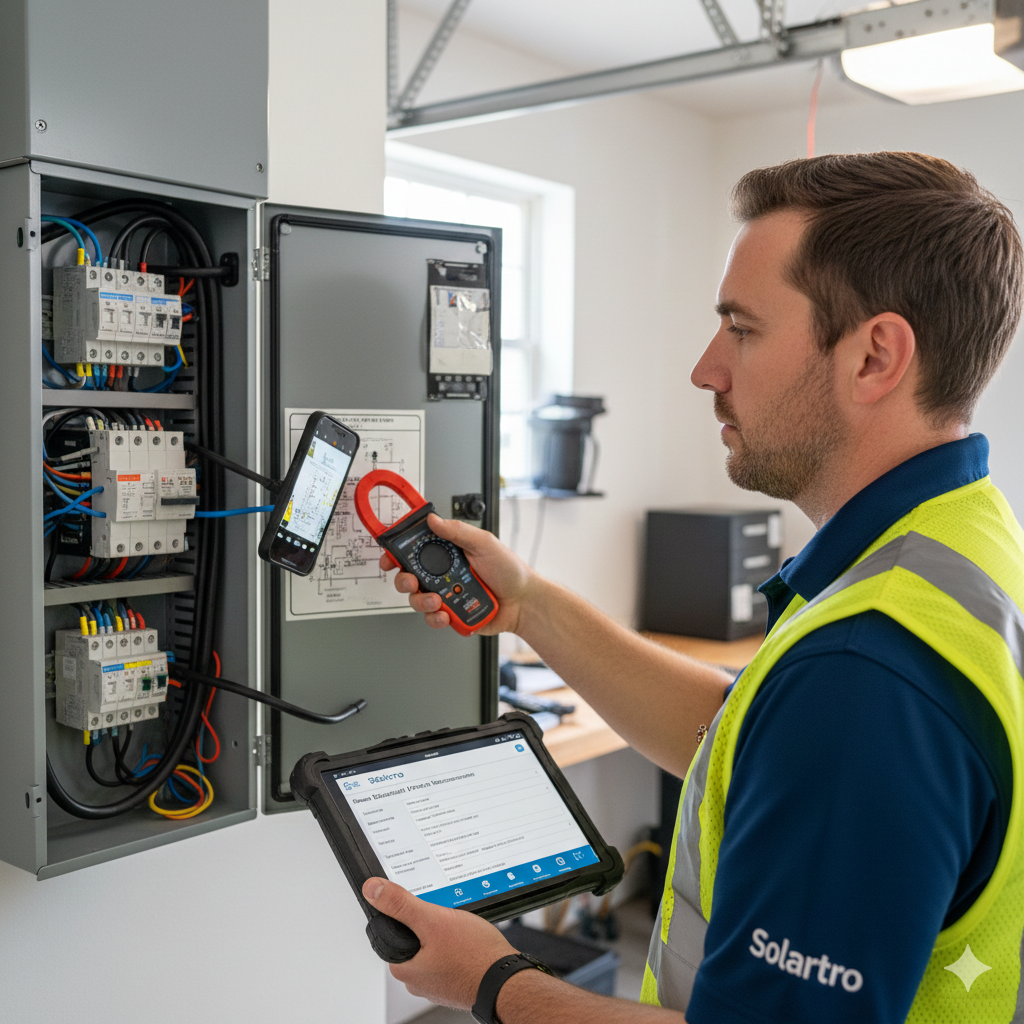
  • Main Service Panel (MSP) Inspection:
    • Panel photos: Front view (door closed with labels visible), interior view (breakers visible), close-up of rating label
    • Panel specifications: Manufacturer, model number, main breaker size (amps), bus bar rating, voltage (120/240V single-phase or 208/480V three-phase)
    • Available space: Open breaker slots, physical space for additional breakers or interconnection equipment
    • Panel condition: Age, corrosion, burnt connections, safety concerns (Federal Pacific, Zinsco panels flagged)
    • Panel location: Distance from proposed solar interconnection point, conduit routing feasibility
  • Subpanels & Load Centers:
    • Identification of all subpanels and their purposes (garage, ADU, workshop)
    • Subpanel locations, sizes, and available capacity
    • Potential for battery backup integration to critical load subpanels
  • Utility Meter:
    • Meter photos: Close-up showing meter number, meter socket type (ring/ringless), seal condition
    • Meter specifications: Analog vs. digital/smart meter, single vs. multi-phase, socket accessibility
    • Distance to MSP: Conduit routing path from meter to main panel (for line-side tap interconnections)
  • Gas meter:
    • Gas meter location: Photos, measurements (height, width, distance to MSP), map notation
    • Clearance from solar equipment: Ensuring proper spacing from electrical components
  • Service Entrance & Utility Connection:
    • Service drop vs. underground: Overhead utility lines (mast height, clearance) or underground lateral
    • Service wire size: Estimated ampacity of utility service conductors
    • Grounding system: Location of grounding electrode (ground rod, water pipe, Ufer ground)
  • Electrical Capacity Analysis:
    • Total connected load estimate (for load calculations)
    • Service upgrade requirement assessment (is 200A service sufficient or upgrade to 400A needed?)
    • Interconnection method feasibility: Supply-side tap, load-side breaker (120% rule), separate service

Battery & Existing System Review (If Applicable)

  • Battery Installation Location Evaluation:
    • Indoor options: Garage walls, utility rooms, basements—measuring available wall space, clearances, ventilation
    • Outdoor options: Exterior walls, weatherproof pad locations—assessing NEMA enclosure requirements
    • Code clearances: Fire-rated wall requirements (NFPA 855), minimum distances from combustibles, egress paths
    • Battery types compatibility: Tesla Powerwall mounting, Enphase IQ Battery cabinet dimensions, LG Chem/Generac requirements
  • Backup Load Planning:
    • Critical circuits identification: Which loads does customer want backed up
    • Load center options: Existing subpanel vs. new critical load panel installation space
    • ATS (Automatic Transfer Switch) location: Physical space for transfer switch near main panel
  • Generator Integration (if existing or planned):
    • Existing backup generator location, fuel type (natural gas, propane, diesel), size (kW)
    • Generator interconnection method and compatibility with solar + battery system
    • Tri-fuel/hybrid system coordination requirements

Ev Charger Infrastructure (if applicable)

  • Electric Vehicle Charging Station Assessment:
    • Charger location planning: Garage wall, carport, driveway pedestal—measuring distances to service panel
    • Electrical capacity: Dedicated 40A-100A circuit requirement, conduit routing feasibility
    • Load management: Coordinating EV charger load with solar production and battery storage
    • Future-proofing: Conduit stubouts or pre-wiring for future EV adoption

Our Site Survey Process

Simple, Transparent, and Efficient

  • Step 1: Project Intake
    • Submit project details via our online portal, email, or phone
    • Provide: Property address, homeowner contact (if on-site), project type (roof/ground/battery), special requirements
    • Receive instant quote and timeline
  • Step 2: Survey Scheduling (On-Site Surveys)
    • We coordinate directly with homeowner or your team
    • Flexible scheduling—evenings and weekends available
    • Average survey duration: 45-90 minutes depending on complexity
  • Step 3: Data Collection
    • Certified surveyor conducts thorough inspection
    • Photos, measurements, notes, and assessments captured using professional tools
    • Homeowner walkthrough and Q&A (if present)
  • Step 4: Survey Report Delivery
    • 12-24 hour turnaround (on-site) or 4-12 hours (remote)
    • Comprehensive photo package, detailed report, measurements, and notes
    • Delivered via secure cloud link with organized folder structure
  • Step 5: Design Handoff
    • Survey data seamlessly transfers to our design engineering team
    • No information gaps—one team, one workflow, zero friction
    • Your permit-ready plan set is underway immediately

Our Site Survey Process

Simple, Transparent, and Efficient

  • Step 1: Project Intake
    • Submit project details via our online portal, email, or phone
    • Provide: Property address, homeowner contact (if on-site), project type (roof/ground/battery), special requirements
    • Receive instant quote and timeline
  • Step 2: Survey Scheduling (On-Site Surveys)
    • We coordinate directly with homeowner or your team
    • Flexible scheduling—evenings and weekends available
    • Average survey duration: 45-90 minutes depending on complexity
  • Step 3: Data Collection
    • Certified surveyor conducts thorough inspection
    • Photos, measurements, notes, and assessments captured using professional tools
    • Homeowner walkthrough and Q&A (if present)
  • Step 4: Survey Report Delivery
    • 12-24 hour turnaround (on-site) or 4-12 hours (remote)
    • Comprehensive photo package, detailed report, measurements, and notes
    • Delivered via secure cloud link with organized folder structure
  • Step 5: Design Handoff
    • Survey data seamlessly transfers to our design engineering team
    • No information gaps—one team, one workflow, zero friction
    • Your permit-ready plan set is underway immediately

Site Survey Deliverables Checklist

When you choose Solartro, you receive a complete, permit-ready survey package:

  • 50-150+ high-resolution site photos (organized by category: exterior, roof, electrical, attic, obstructions)
  • Detailed written survey report (roof specs, electrical data, shading notes, structural observations)
  • Accurate roof measurements (dimensions, pitch, orientation, area calculations)
  • Comprehensive shading analysis (solar access percentage, obstruction mapping, seasonal impact)
  • Electrical panel assessment (panel size, condition, available capacity, interconnection feasibility)
  • Structural evaluation (roof type, age, condition, load-bearing capacity notes)
  • AHJ compliance documentation (fire setbacks, code notes, local requirements)
  • CAD-ready data (measurements formatted for seamless design integration)
  • Secure cloud delivery (organized folders, encrypted transfer, data privacy protected)

Everything your design and permitting team needs—nothing more, nothing less.

Why Choose Solartro for Site Surveys?

Nationwide Coverage, Local Expertise

  • Certified surveyors in all 50 states
  • Deep knowledge of local AHJ requirements, code variations, and permitting nuances
  • Familiar with regional roof types, weather considerations, and installation challenges

Strict Privacy & Data Security

  • HIPAA-level data protection standards
  • Encrypted file transfers and secure cloud storage
  • No sharing of customer information with third parties
  • Data retention policies compliant with industry standards

Fastest Turnaround in the Industry

  • On-site surveys delivered in 12-24 hours
  • Remote surveys completed same-day or next-day
  • Real-time communication—no waiting days for data

Engineer-Grade Accuracy

  • Surveys designed by engineers, for engineers
  • Data formatted specifically for permit design teams
  • All measurements verified and cross-checked for precision

Transparent Pricing

  • Fixed, upfront pricing—no surprise charges
  • Volume discounts for high-volume installers
  • Bundled survey + design packages available

Freequently Asked Questions

What does the Solar Proposal Design service include?

Complete proposal drawings (2D/3D), production & shading analysis, financial projections (payback, NPV, LCOE), equipment specifications, and client-ready presentation files (web link, PDF, slides).

How do you determine the right system size?

We analyze historical energy usage (if provided), roof constraints, shading analysis, and client goals (target offset %) to recommend optimal sizing. Can design from address-only or with detailed utility data.

How fast can I get a proposal?

Standard delivery: 12 hours. Priority: 4-6 hours. Express (high-volume partners): 30 minutes to 2 hours. 24/7 operations for global time zone support.

Is this service suitable for new installers?

Absolutely! Our professional proposals help new installers establish credibility from day one—clients can't tell if you've done 5 projects or 500 projects based on proposal quality.

How accurate are the savings estimates?

All projections are climate-specific, degradation-adjusted, and based on industry-validated modeling (NREL methodologies). We use real weather data, not national averages. Accuracy within ±5% of actual performance.

Can you support permits after the proposal stage?

Yes! Our proposal designs are fully compatible with our downstream Solar Site Surveys services. Seamless handoff from sales → permitting with zero data loss.

What if my client wants revisions after seeing the proposal?

Minor revisions (panel count adjustments, equipment swaps) are typically included. Major scope changes (different roof, system size changes) may require additional design time. High-volume partners get priority revision support.

How much does proposal design cost?

Pricing varies by project complexity, volume, and turnaround speed. Contact us for custom quotes—volume discounts available for installers with recurring needs.

How long does a site survey take?

On-site residential surveys: 45-90 minutes. Remote surveys: 4-12 hours for report delivery. Commercial/ground-mount: 2-4 hours depending on site size.

Do I need to be present during the survey?

Not required, but helpful. If the property is vacant or homeowner unavailable, we can coordinate access with your team or use a lockbox. Attic access may require homeowner presence.

What if the roof is too steep or unsafe to access?

We offer drone-assisted surveys for steep/high/unsafe roofs. Drones capture all necessary data without physical roof access.

Can you survey properties nationwide?

Yes! We have certified surveyors covering all 50 U.S. states, including Alaska and Hawaii.

How accurate are remote surveys compared to on-site?

Remote surveys using high-res aerial imagery are highly accurate for roof measurements (±2-3 inches). However, on-site surveys capture additional details like attic framing, electrical panel interior, and roof condition that remote methods cannot assess.

What if the survey reveals problems (bad roof, inadequate panel, shading issues)?

We document all findings honestly. This allows you to address issues proactively—whether that's recommending roof repairs, service panel upgrades, or adjusting the system design. It's far better to identify problems during survey than mid-installation.

Do you provide surveys for battery/generator installations?

Absolutely. Our surveys include battery location assessment, generator pad evaluation, electrical capacity analysis, and ATS (Automatic Transfer Switch) placement planning.

How is survey data delivered?

Via secure cloud link (Dropbox, Google Drive, or your preferred platform). Files are organized in folders (Photos, Report, Measurements) for easy navigation. Data is encrypted and privacy-protected.

Can I order a survey without ordering permit design?

Yes, surveys are available as standalone services. However, bundling survey + design saves time and money, with seamless data handoff between teams.

How much does a site survey cost?

Pricing varies based on project type, location, and survey method (on-site vs. remote). Contact us for a custom quote: [info@solartro.com] or [+1 307-429-3502].